
#TODO
From Wikipedia
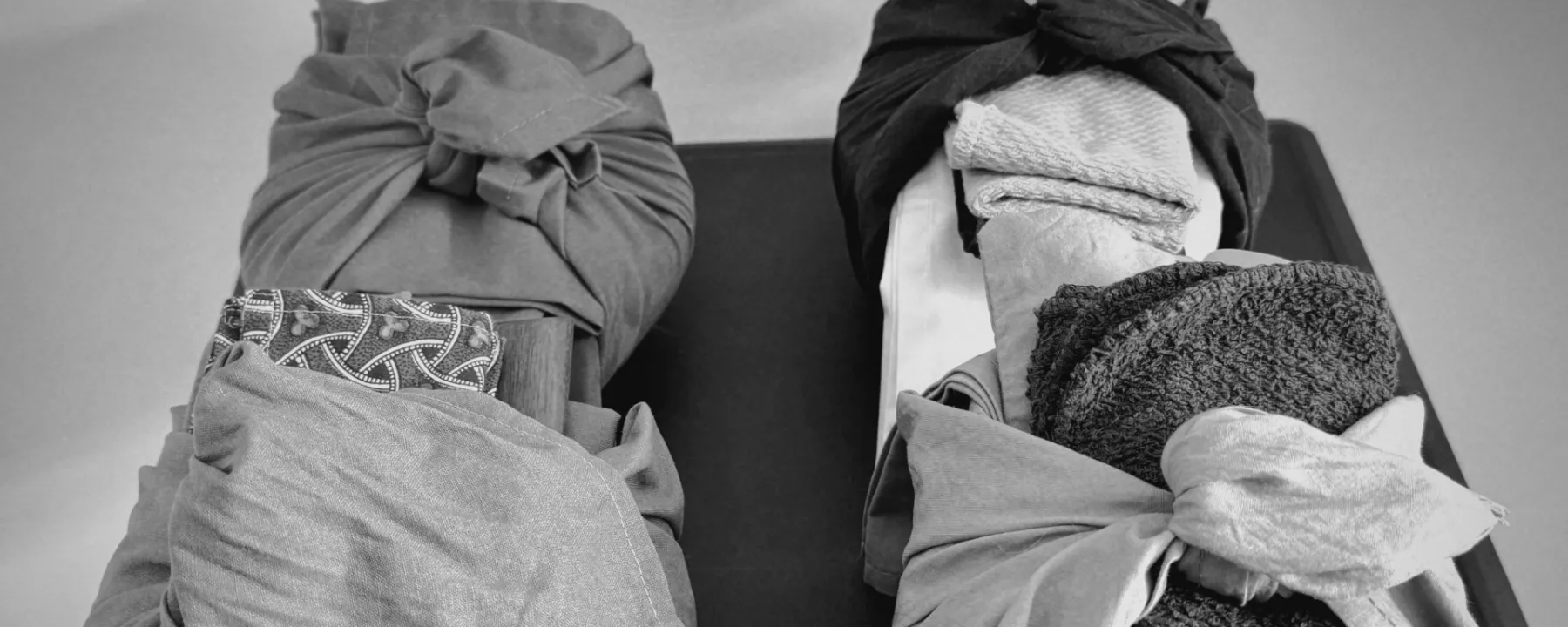
The term "ōryōki" is mostly used in the sōtō-shū (曹洞宗) sect of Zen Buddhism. In the rinzai-shū (臨済宗) and ōbaku-shū (黄檗宗) sects, the utensils are called jihatsu, which is written as 持鉢 according to rinzai-shū and 自鉢 according to ōbaku-shū. Jihatsu is also used to refer to the bowls alone The bowls usually made of lacquered wood, and utensils all bundled in a cloth. The largest bowl, sometimes called the Buddha Bowl or zuhatsu, symbolizes Buddha's head and his wisdom. The other bowls are progressively smaller. In describing the form of ōryōki used at John Daido Loori's Zen Mountain Monastery, author Jack Maguire wrote:
The cantaloupe-sized bundle consists of three black plastic nesting bowls, two chopsticks, a wooden spoon, a small rubber spatula, a gray napkin, and a wiping cloth, all of which are wrapped tidily in a gray cloth with a topknot resembling a lotus blossom.
This is the formal style of serving and eating meals practiced in Zen temples.Buddhist tradition states that after Huineng received the monk's robe and bowl as evidence of his having received Dharma transmission, the bowl itself was considered a symbol of transmission from teacher to student. Ōryōki have evolved in Buddhist monasteries in China and Japan over many years and are part of the Buddhist tradition that has now been transmitted to the West. Both monks and laypeople use ōryōki to eat formal meals in Zen monasteries and places of practice. A lineage was also transmitted from Kobun Chino Roshi to the Tibetan Buddhist sangha of Chögyam Trungpa Rinpoche and is now practiced at all Shambhala retreat centers.Zen teachers say that taking meals with ōryōki cultivates gratitude, mindfulness, and better understanding of self. (In this regard, it is not unlike zazen.) The intricacies of the form may require the practitioner to pay great attention to detail.
From Sotoshu - The Form of the Dharma that Appears in the Etiquette of Oryoki
Since a principle of the Buddhadharma says that all phenomena are without self and that all living beings which exist within this phenomenal world are also without self, then by definition human beings and their activities are without self. The daily activity of “eating” as well, which is repeated endlessly through the life of a human being, is a manifestation of this truth of “no self.” On one level, we can see that we are given the opportunity to embody the place of “food” which stands face-to-face with the Dharma when we sit zazen. For us who live as monks, this is our good fortune, so we must not neglect this opportunity nor be careless with it.
The “Dharma” and “food” are one true form and cannot be handled in an ordinary confrontational or comparative way. Whenever we spread out the oryoki bowls, we must think deeply about Dogen Zenji's words and thought in "The Dharma for Taking Food", and we must actually feel them and meet the Way through them: "Let the Dharma be the same as food and let food be the same as the Dharma" and "the Dharma is food, food is the Dharma."
It is a wonderful that Dogen Zenji's intention for practicing with the etiquette for eating is now being practiced throughout the world. For beginners, this way of eating may seem at first to be bothersome. However, as you come to understand that each movement and activity is the Dharma as well as a new existence, you will see that this activity of monks, which everyone can use and apply to their lives, is itself nothing other than the manifestation of the no-self of the Dharma and the no-self of human beings. At that time, each of you will deeply realize that this writing about oryoki is not simply about ceremony and etiquette.