
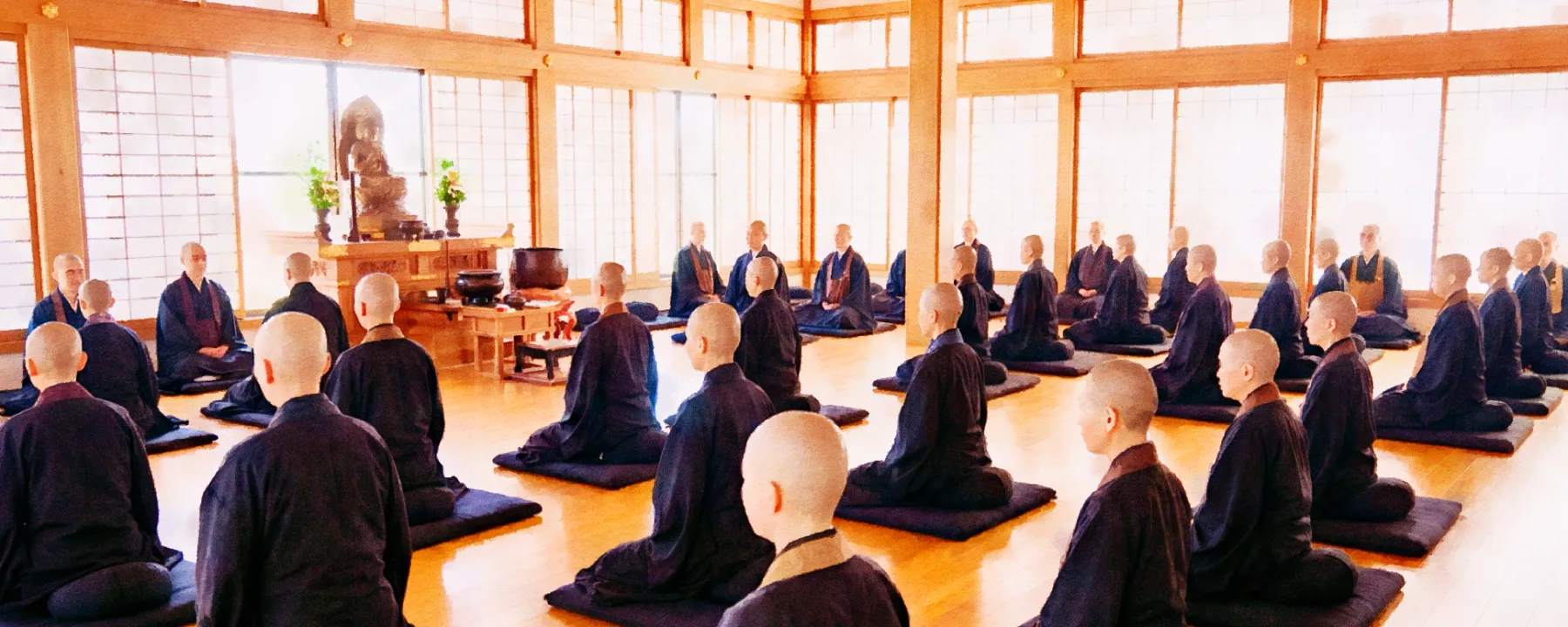
Eihei Dogen taught that shikantaza is not a means to enlightenment — it is the expression of enlightenment. Practice and realization are not two separate things.
To manifest our Buddha nature, we take the actions of a Buddha.
Or perhaps:
We don't sit in order to become a buddha. We sit because we already are one.
~Brian Joshin Byrnes
Etymology
| Japanese | Kanji | Meaning |
|---|---|---|
| shikan | 只管 | "only," "just," "wholeheartedly" |
| ta | 打 | intensifier; "to strike" (emphasis) |
| za | 坐 | seated; sitting |
The compound renders the Chinese zhǐguǎn dǎzuò from the Caodong (Sōtō) school. Zhǐguǎn means "only concerned with"; dǎzuò refers to seated meditation.
Historical Origins
Silent Illumination (Caodong / Sōtō lineage)
The practice descends from silent illumination (mòzhào) taught in the Chinese Caodong school. Hongzhi Zhengjue (1091–1157) gave it its fullest early expression:
Silent and serene, forgetting words, bright clarity appears before you. When you reflect it, you become vast. When you embody it, you are spiritually uplifted. Spiritually solitary and shining, inner illumination restores wonder.
Dogen's Transmission
As a young person Eihei Dogen (1200–1253) had a driving question: if all beings already possess Buddha-nature (as the Tendai school taught), then why does anyone need to practice? This question ultimately drove Dogen across the sea to China where he eventually encountered the teaching directly under Tiantong Rujing (1162–1228). When Rujing instructed: "Just sit; only then will you attain it," Dogen experienced shinjin datsuraku - "body and mind dropping off" (a profound awakening). This became the foundation of the Soto Zen school he established in Japan.
Dogen's formulation may seem paradoxical: by adopting the posture and actions of the buddhas and ancestors, the practitioner becomes identical to them in body and mind. Sitting is not practice toward some goal; sitting and goal are one. His answer does not resolve the tension between practice and enlightenment. It eliminated the assumption that they were two different things.
Core Principles
- Non-striving: No attempt to achieve any particular state — no calm, no insight, no enlightenment
- Objectless awareness: Unlike breath-counting or shamatha, there is no anchor object; awareness is open and panoramic
- Body as practice: The physical posture of zazen is itself transformative — not merely a container for mental activity
- Practice-realization are one (shushō ittō): Sitting is the expression of already-awakened nature, not a path toward it
- jijuyu zanmei: "Self-fulfilling samadhi" — Dogen's term for the state in which practice and realization interpenetrate
On Thinking
Yaoshan Weiyan was asked: "What do you think about while sitting?" He replied:
Think not-thinking. How do you think not-thinking? Nonthinking.
This is not suppression of thought. It is awareness that is not captured by thought — thoughts arise and pass without identification or elaboration. Kodo Sawaki Roshi called it "good for nothing," meaning it is not transactional, not instrumental — and therefore, the most complete thing there is.
Relationship to Other Practices
| Practice | Object / Method | Goal |
|---|---|---|
| Shikantaza | None (objectless) | Expression of awakened nature |
| shamatha | Breath, object, or mantra | Calm abiding; concentration |
| Koan practice (Rinzai) | Koan / huatou | Breakthrough insight (kensho) |
| Vipassana | Body sensations / phenomena | Insight into impermanence, anattā |
Shikantaza is sometimes misread as passive. Teachers consistently emphasize that it requires full, alert presence — not relaxed inattention.
How to Practice
- Find a quiet place; sit upright on a cushion or chair — relaxed but alert
- Hands in cosmic mudra in the lap; eyes softly open, gaze downward at ~45°
- Let the breath breathe itself — do not manipulate it
- Allow sounds, sensations, thoughts, and feelings to arise and pass without grasping or pushing away
- When the mind wanders, gently return — this returning is the practice
- No fixing. No improving. Nothing missing.