
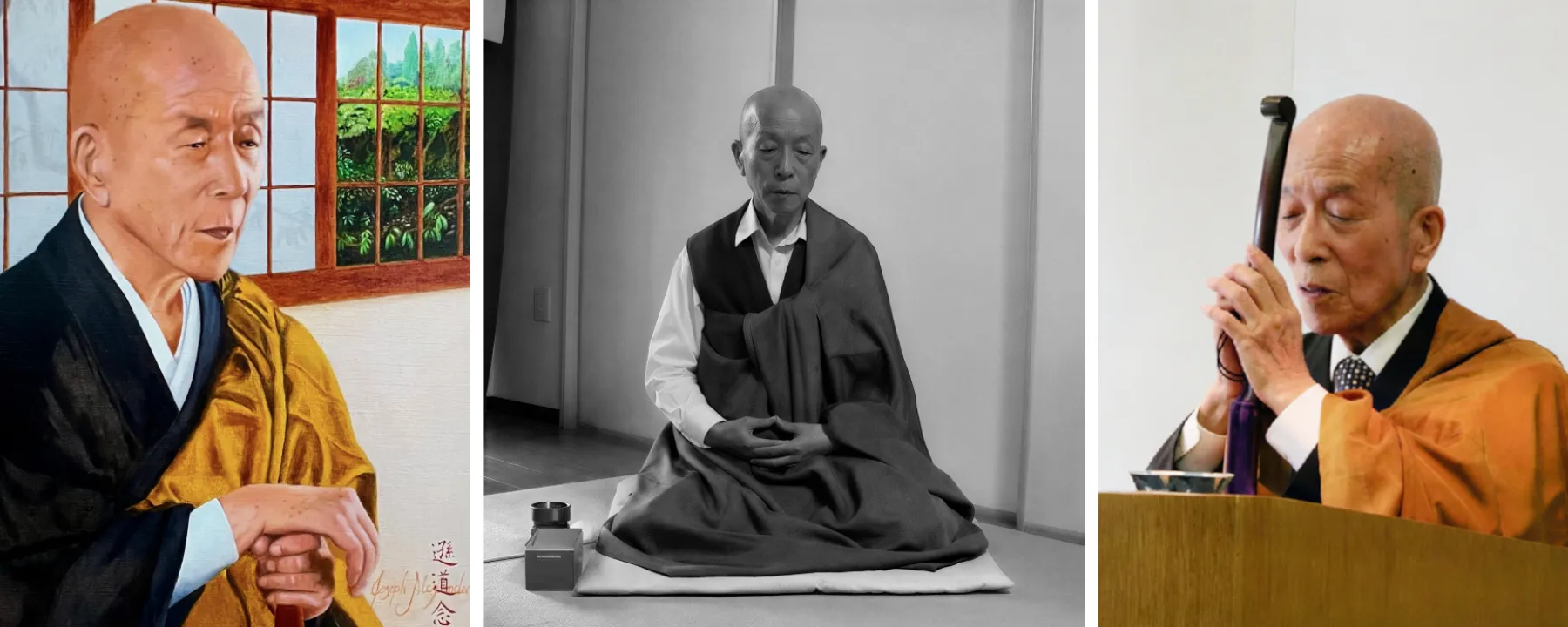
Born in Yokohama, Gudo Nishijima came to formal priesthood late and followed an unconventional path. He encountered the Dharma as a young man in the early 1940s, becoming a student of "homeless" Kodo Sawaki. Sawaki was known for his efforts to restore ShikantazaShikantaza (只管打坐, shikan ta za) — "just sitting," or more precisely, "nothing but wholeheartedly sitting" - is the zazen practice central to Soto Zen Buddhism. It is objectless, goalless, method-free meditation: open awareness without a focus point, without striving toward any particular state. Read more about Shikantaza » to the center of Buddhist practice. Nishijima Roshi shared deeply in Sawaki's emphasis on ShikantazaShikantaza (只管打坐, shikan ta za) — "just sitting," or more precisely, "nothing but wholeheartedly sitting" - is the zazen practice central to Soto Zen Buddhism. It is objectless, goalless, method-free meditation: open awareness without a focus point, without striving toward any particular state. Read more about Shikantaza »: holding throughout his life that ZazenShikantaza (只管打坐, shikan ta za) — "just sitting," or more precisely, "nothing but wholeheartedly sitting" - is the zazen practice central to Soto Zen Buddhism. It is objectless, goalless, method-free meditation: open awareness without a focus point, without striving toward any particular state. Read more about Zazen » is not preparation for awakening but the realization of reality itself.
After the second world war Nishijima Roshi completed a law degree at Tokyo University and spent a professional life in finance, but also lectured publicly on Buddhism and Zen meditation through the 1960s. Gudo did not become a priest until 1973 (when he was in his mid-fifties). By that time Kodo Sawaki had passed away, so he was ordained by Zuigaku Rempo Niwa former head of the Soto school and 77th abbot of Eihei Dogen's Eihei-ji monastery. Four years later Niwa Zenji gave Gudo shiho, formally recognizing him as one of Niwa-zenji's Dharma successors in the 90th generation of Buddhist ancestors since Shakyamuni Buddha. He continued his professional work until 1979: a living example of a Buddhism that can be carried in the midst of ordinary life rather than apart from it.
Nishijima Roshi is well known for his work translating fascicles of Eihei Dogen's Shobogenzo into modern Japanese, and later into English as well. Working with his Dharma heir Chodo Mike Cross, he produced a complete English translation of Dogen's ninety-five-fascicle Kana Shobogenzo; his translation work also includes Dogen's Chinese-language koan collection, the Shinji Shobogenzo, and Nāgārjuna's Fundamental Verses of the Middle Way (Mūlamadhyamakakārikā).
Underlying all of these translations was an interpretive framework he termed: "three philosophies and one reality." This was Nishijima Roshi's reading of Dogen and of the Four Noble Truths as a movement through four perspectives:
- The idealistic and subjective
- The materialistic and objective
- A realistic synthesis of the subjective and objective
- Reality itself: which can neither be contained in philosophy nor stated in words
This "reality itself" is what Dogen points toward through poetry and symbol. For Nishijima Roshi this was not a scholarly overlay but the actual structure of the Shobogenzo, and the ground of his conviction that Buddhism is above all: realistic - a matter of action in the present moment.
A reformer at times at odds with the Buddhist establishment, Nishijima Roshi nevertheless transmitted the Dharma to successors who carry his lineage forward today through their own practice and Sanghas around the world. He continued to sit daily zazen into his nineties and passed away in 2014 at the age of ninety-four.
Dharma Heirs (Partial List)
- Gil Alon1
- Nissim Amon2
- Tenryu Jean-Marc Bazy3
- Luis Diaz Broughton4
- Chigen Jundo CohenChigen Jundo Cohen (智源 純道 b. July 14, 1960, New York, New York) is a Sōtō Zen Priest, founder and teacher of the Treeleaf Zendo, a Soto Zen Sangha located in Tsukuba, Japan. He was ordained in 2002 and subsequently received Dharma Transmission from Master Gudo Wafu Nishijima in the Niwa-Nishijima… Read more about Chigen Jundo Cohen »5
- Chodo Mike Cross6
- Gustav Ericsson7
- Ritsunen Gabriele Linnebach8
- Eido Michael Luetchford9
- Nicole de Merkline10
- Ritsudo Richard Morrissey11
- Jeremy Pearson12
- Yudo Michel Proulx13
- Peter Rocca14
- Jiun Eric Rommeluère15
- Yudo Juergen Seggelke16
- Doko Dagmar Waskoenig17
- Brad Warner18
- Gerhard Wolfgram19
Sekishi's Reflections
The photographs of Nishijima Roshi wearing the kesa or rakusu over business clothes says something to me that words struggle to - wearing the kesa of a working person. Not a layperson borrowing the trappings of a priest, but a full Soto transmission carried without a temple to keep or a life renounced. Simply the whole of a life "worn" at once.
ZazenShikantaza (只管打坐, shikan ta za) — "just sitting," or more precisely, "nothing but wholeheartedly sitting" - is the zazen practice central to Soto Zen Buddhism. It is objectless, goalless, method-free meditation: open awareness without a focus point, without striving toward any particular state. Read more about Zazen » is not preparation for awakening but the presentation of reality itself. This is the thread we householder heirs take up: a complete Dharma standing lived inside ordinary life, with its rent, and chores, and day-jobs: not two.
https://espanol.buddhistdoor.net/el-legado-de-gudo-wafu-nishijima-en-chile-primera-parte/ ↩
Nishijima, Gudo, and Chodo Cross. Preface. Master Dogen's Shobogenzo, Book 1, Windbell Publications, 1994, p. ii. ↩
https://www.inebcounseling.net/overcoming-contradictions-bangkok-2023/ ↩
https://forum.treeleaf.org/forum/treeleaf/treeleaf-community-topics-about-zen-practice/archive-of-older-threads/3130-dharma-transmission-from-nishijima-roshi ↩
https://forum.treeleaf.org/forum/treeleaf/treeleaf-community-topics-about-zen-practice/archive-of-older-threads/3130-dharma-transmission-from-nishijima-roshi ↩
https://buddhismus-deutschland.de/yudo-juergen-seggelke-ist-gestorben/ ↩
https://www.buddhistwomen.eu/EN/index.php/Documentation/DagmarWaskoenig ↩
https://forum.treeleaf.org/forum/treeleaf/treeleaf-community-topics-about-zen-practice/archive-of-older-threads/3130-dharma-transmission-from-nishijima-roshi ↩