
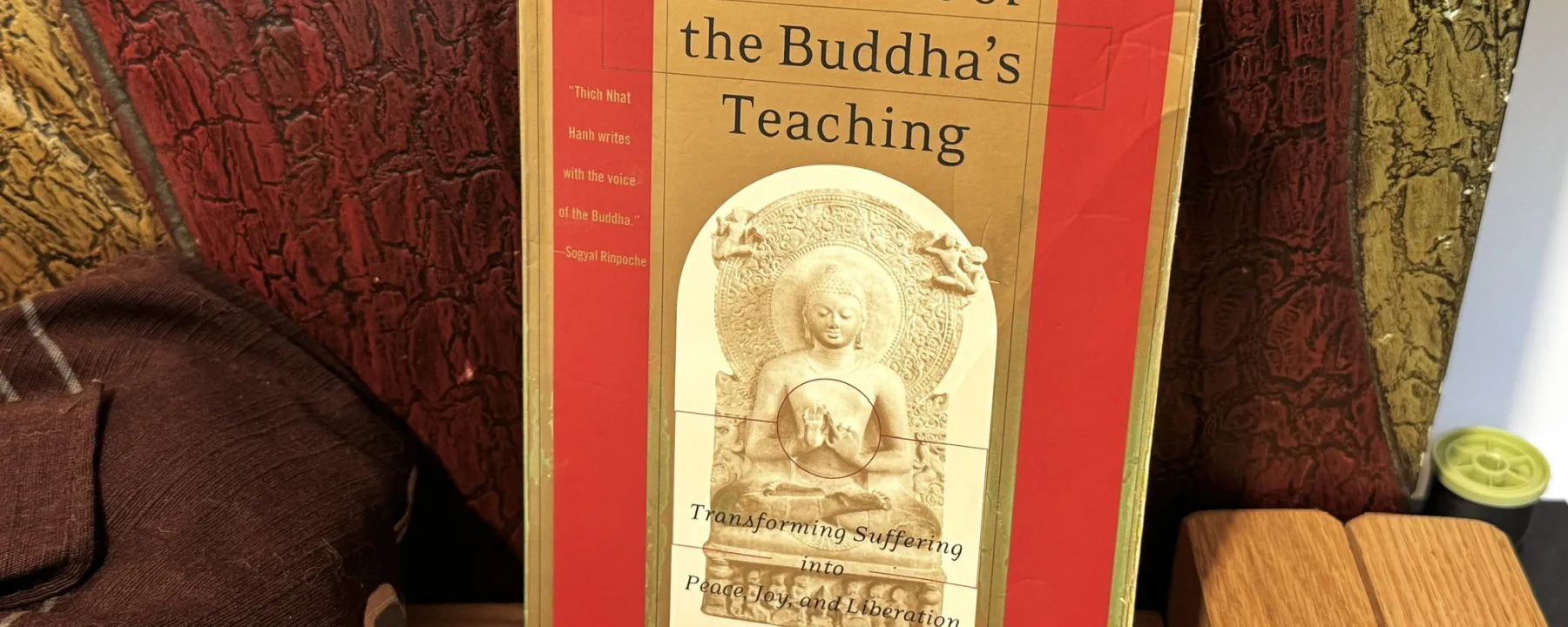
For Ango 2026, we are going to start one of my favorite books about the core teachings of Buddhism: The Heart of the Buddha's Teaching by Vietnamese thiền teacher Thích Nhất Hạnh. The plan is to read one chapter every two weeks, discussing and reflecting together. The book is long enough that we will still be working on it well past the end of Ango.
In multiple conversations around the Sangha, people have mentioned some version of wanting to "get back to basics" and spend time with core teachings. For me personally that means spending some time with "Big B" Buddhism: the shared ground that our many Buddhist traditions sprout from. This book is one of the best presentations of that garden that I know of.
Its difficult to overstate Thích Nhất Hạnh's (or simply "Thay's") influence on Western Buddhist practice. Even if one does not practice in his specific tradition, his books are ubiquitous, and his gentle teachings are simple, clear, and accessible.
The Heart of the Buddha's Teaching is a little different than many of Thay's books. Instead of his own reflections on life and practice, it is a walk through many of the core teachings of Buddhism, covering topics such as:
- the Four Noble Truths
- the Noble Eightfold Path
- the Two Truths
- the Three Dharma Seals
- the Three Doors of Liberation
- the Three Bodies of Buddha
- the Three Jewels
- the Four Immeasurable Minds
- the Five Aggregates
- the Five Powers
- the Six Paramitas
- the Seven Factors of Awakening
- the Twelve Links of Dependent Origination
My copy is faded, bent, and dog-eared: showing the deepest signs of a beloved book.
"Thiền" is the Vietnamese reading of "禪". "Zen" is the Japanese reading of this same word. It is my understanding that Thay and the Plum Village tradition trace largely through the the Lâm Tế (Linji) line. Linji is the same house that became Rinzai in Japan. Our own path runs through Caodong and Dōgen instead.
In practical terms, we are going to encounter some differences in emphasis. For example, Thay and Plum Village lean more on sutra study, and includes some devotional forms and practices we do not. Certainly, Thay puts an emphasis on the cultivation of an intentional mindfulness (smṛti / sati) which may seem like a different focus than our emphasis on "just sitting".
I think this is all OK, and there is no real contradiction, just a different focus. It is my hope that holding and exploring similarities brings far more depth and understanding than getting hung up on apparent differences.
Comments